Throughout my career in O.R., I have had a dilemma about the role of mathematics in what I do. When I talk to other people on a casual, friend to friend basis, I often say that I do mathematics, and immediately add that I do the "Interesting stuff, the stuff with everyday applications". When I talk to clients or those sponsoring projects, I may talk about modelling. With students, I will talk about the mathematics that lies behind models, but will stress that these models need to be appropriate, easy to understand, and applied with political and psychological insights. As has been said many times, "A manager would rather live with a problem s/he can't solve than a solution s/he can't understand".
So I am not sure whether or not I ought to be recommending the website:
www.travelsinamathematicalworld.co.uk. It has accounts of careers in mathematical areas, as part of a process of making information about these available to a wide readership or listeners to podcasts. I came across the account by Professor Mike Maher, whose title is Professor of the Mathematical Analysis of Transport Systems at the (UK) University of Leeds. He describes the use of O.R. models in several areas of transport, mainly traffic assignment. He concludes:
"The skills that I enjoy employing are modelling skills - taking a real-world problem, and trying to formulate it as s mathematical problem with sufficient realism that the outputs can be taken seriously but simply enough to stand a chance of solving it. Then formulating some method, an algorithm, by which the problem can be solved efficiently and robustly. And in the field of transport, there is no shortage of problems!"
Isn't that what O.R. is about? Especially, I hope, "enjoyment".
Showing posts with label traffic flow. Show all posts
Showing posts with label traffic flow. Show all posts
Tuesday, 14 April 2009

Tuesday, 3 March 2009
Measuring the difficult
Sometimes in operational research it becomes necessary to measure something which is difficult. From time to time, the O.R. literature reports on studies which fall in this category, and it is fascinating to see how the profession tackles the problem of measuring the difficult. Statisticians have techniques for surveys which ask extremely sensitive questions.
I have just come across a paper which falls in this "Fascinating how the research measured the difficult". How do you measure people's journeys in an elevator? Here's the citation:
@ARTICLE{Fascinating,
AUTHOR ="Kiyoshi Yoneda",
TITLE ="Elevator Trip Distribution for Inconsistent Passenger Input-Output Data",
JOURNAL ="Decision Making in Manufacturing and Services",
YEAR = "2007",
volume = "1",
number = "1/2",
pages = "175--190",
note = "Fukuoka University, Fukuoka, 814-0180 JAPAN",
abstract = "Accurate traffic data are the basis for group control of elevators and its performance evaluation by trace driven simulation. The present practice estimates a time series of inter-floor passenger traffic based on commonly available elevator sensor data. The method demands that the sensor data be transformed into sets of passenger input-output data which are consistent in the sense that the transportation preserves the number of passengers. Since observation involves various behavioral assumptions, which may actually be violated, as well as measurement errors, it has been necessary to apply data adjustment procedures to secure the consistency. This paper proposes an alternative algorithm which reconstructs elevator passenger origin-destination tables from inconsistent passenger input-output data sets, thus eliminating the ad hoc data adjustment.",
file = F
}
One of my colleagues was involved in a study of what coins people would put into a slot machine that gave change, in order to determine what mix of change the machine should have. He started with a survey of the students we teach, and then asked them to repeat the survey with ten friends.
On the subject of elevators, I liked "10 Clever Elevator Ads".
I have just come across a paper which falls in this "Fascinating how the research measured the difficult". How do you measure people's journeys in an elevator? Here's the citation:
@ARTICLE{Fascinating,
AUTHOR ="Kiyoshi Yoneda",
TITLE ="Elevator Trip Distribution for Inconsistent Passenger Input-Output Data",
JOURNAL ="Decision Making in Manufacturing and Services",
YEAR = "2007",
volume = "1",
number = "1/2",
pages = "175--190",
note = "Fukuoka University, Fukuoka, 814-0180 JAPAN",
abstract = "Accurate traffic data are the basis for group control of elevators and its performance evaluation by trace driven simulation. The present practice estimates a time series of inter-floor passenger traffic based on commonly available elevator sensor data. The method demands that the sensor data be transformed into sets of passenger input-output data which are consistent in the sense that the transportation preserves the number of passengers. Since observation involves various behavioral assumptions, which may actually be violated, as well as measurement errors, it has been necessary to apply data adjustment procedures to secure the consistency. This paper proposes an alternative algorithm which reconstructs elevator passenger origin-destination tables from inconsistent passenger input-output data sets, thus eliminating the ad hoc data adjustment.",
file = F
}
One of my colleagues was involved in a study of what coins people would put into a slot machine that gave change, in order to determine what mix of change the machine should have. He started with a survey of the students we teach, and then asked them to repeat the survey with ten friends.
On the subject of elevators, I liked "10 Clever Elevator Ads".
Monday, 2 March 2009
The curse of the sat-nav system
In the UK, and I guess in most other countries, satellite navigation systems (sat-navs) are a blessing and a curse. Surprisingly little has been published about the design of the algorithms used in them, though essentially they use modified forms of Dijkstra's method, which is also the dynamic programming approach. A fellow blogger has commented on some of the stories from the UK, Belgium and the Netherlands.
Over a meal on Friday evening, friends were talking about stories which don't reach the national papers. They mentioned the large number of small sites for caravans (there is a club which has private use of fields in many farms) which have the warning "Do not use sat nav" in their guide-book. Another friend mentioned that a passenger ferry across a river, at the end of a lane, is marked as accessible to vehicles.
There are several problems with sat-navs that these stories highlight. Most obvious is that data can be incorrect, and once published, is hard to retract. Next is that data may change; roads can be closed for repair, and even online updates may not help, even if the user chooses to subscribe to such a facility. But from an O.R. point of view, there is the question of the wrong algorithm. Many of the problems could be dealt with if the algorithm took into account the kind of vehicle, which would mean solving a constrained shortest path problem ... and for nearly all cases, that would mean using the normal algorithm on a modified dataset. But that would increase the price of the system.
So we end up with people cursing the system, damage to property thanks to incorrectly routed vehicles, a cost to society with special road signs trying to stop vehicles routed with sat-nav ....
Over a meal on Friday evening, friends were talking about stories which don't reach the national papers. They mentioned the large number of small sites for caravans (there is a club which has private use of fields in many farms) which have the warning "Do not use sat nav" in their guide-book. Another friend mentioned that a passenger ferry across a river, at the end of a lane, is marked as accessible to vehicles.
There are several problems with sat-navs that these stories highlight. Most obvious is that data can be incorrect, and once published, is hard to retract. Next is that data may change; roads can be closed for repair, and even online updates may not help, even if the user chooses to subscribe to such a facility. But from an O.R. point of view, there is the question of the wrong algorithm. Many of the problems could be dealt with if the algorithm took into account the kind of vehicle, which would mean solving a constrained shortest path problem ... and for nearly all cases, that would mean using the normal algorithm on a modified dataset. But that would increase the price of the system.
So we end up with people cursing the system, damage to property thanks to incorrectly routed vehicles, a cost to society with special road signs trying to stop vehicles routed with sat-nav ....
Wednesday, 14 January 2009
The psychology of implementation of O.R.

It has been generally acknowledged in the O.R. that I have studied that implementing O.R. needs to recognise the psychology of the eventual user. There are numerous anecdotes and O.R. legends about this. The problem of elevators in the New York skyscraper is one of the oldest.
Office workers complained about the time they had to wait for elevators, so an O.R. team was asked to try and find an appropriate solution.
Various models were built in the investigation. These considered having more elevators, faster elevators, elevators that only stopped at particular floors. All were deemed insufficient.
Then the psychologist on the team proposed that there be full-length mirrors in the lobbies between the doors of the elevators. His argument was that these mirrors would reduce the perceived time of waiting; some people could arrange their clothing and check their hair; others could surreptitiously watch their fellow workers in the mirror. (The original story was sexist; this is the PC version.)
Result: no more complaints. The solution cost very little.
The same solution approach explains why you have magazines in waiting rooms, and automated advertising screens in bank and other queues. (Does anyone know of an airport where the queues are entertained by such screens? In those that I have visited, the queues have to watch endless reminders about what cannot be taken through security, or how to prepare for security.) And it also partly explains the popularity of glass-walled lifts, where there is something to watch while you are travelling.
(By the way, some statistics show that elevators are the safest form of transport in terms of deaths per passenger mile.)
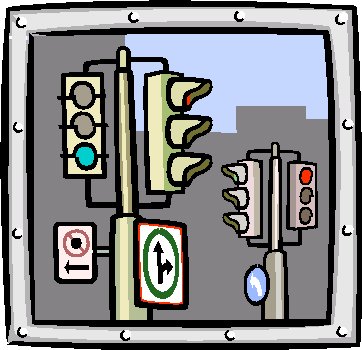
Many years later, I came across a note about differing national psychologies. We were discussing the optimal timing of the red phase on traffic lights at a junction such as a cross roads. In heavy traffic, the throughput is maximised by having very long phases. The constraint is psychological; if the lights do not turn from red to green, those waiting at the red light start to become impatient. My informant suggested that two minutes was the limit in the UK, nearly three in the USA, and in Japan, the patient Japanese motorist only started to fret after four minutes. I'd be interested in knowing the basis for this.
Wednesday, 20 August 2008
O.R. and the Infrastructure (3)
Another thought about the hidden science. In the U.K. (and I guess in many other countries) most traffic lights (whatever you call them) at road junctions are controlled by computer. Detectors are located close to the stop line and also in advance of that line, indicating the presence of vehicles waiting and approaching. (Next time you are cycling or walking past traffic lights, have a look for black tar-covered lines in the tarmacadam, which cover detector wires, or look for miniature radar sets on the lights themselves.) The logic behind the programs that control the lights is developed by O.R. scientists. In the programme about infrastructure "Britain from Above", the presenter visited a traffic control room, where the staff had the power to change lights when their traffic monitoring equipment (including TV cameras) detected congestion. It was left unsaid that most of the time the traffic flow is controlled automatically; the people in the control room had to deal with the exceptions, the unusual. Why can't the computer control be extended to cover these exceptions? Cost and complexity. It would cost too much to build in rules for exceptional cases, which would be complex. It is good O.R. (IMHO) to know when to stop building too complex a model. Besides, traffic control has multiple objectives, and the importance of the different objectives changes with the time of the day and much else.
Subscribe to:
Posts (Atom)