Showing posts with label hidden science. Show all posts

Monday, 15 November 2010

Qantas rescheduling

After a recent "incident" in which an A380 airbus had to abort its flight, all the company's wide-bodied jets have been withdrawn. How does an airline deal with the the knock-on effect of this? They reschedule their flights and passengers. And, we, the public, see the results. Rescheduling has involved the downsizing of aircraft across all Qantas international routes.

Flagship routes to Los Angeles and London from Australia, usually operated by the super-jumbos, will now use older and smaller Boeing 747s, as will all other A380 flights. 100 passengers per flight who were bumped off have been transferred to other airlines.

The downsizing of shorter flights will continue with Boeing 747 flights to Hong Kong and Tokyo now using Airbus 330s, replaced on their normal routes such as Singapore to Perth with even older Boeing 767s. According to the airline, although it is committed to bringing its A380s back into service as early as possible, the new schedules give certainty to those travelling in the near future.

As the Qantas grounding drags on, fares on certain routes have been increased.

That's the public picture; behind this there must have been some complex modelling, which will be kept restricted. Maybe one day, some Qantas O.R. worker will tell us about the models that were hastily built and modified. If you have been involved with a large O.R. problem, then you can imagine what is involved. To replace aircraft A on flight A1 means substituting aircraft B. How many passengers will be lost? What will it cost? But aircraft B was assigned to flight B1 and needs to have a substitute, aircraft C. And so on. Then, the speeds of A, B and C are likely to be different, so there are further consequences.

Which passengers should be bumped? There will be data on the flying habits of the passengers, which can be used to help this. I suspect that the O.R. people at Qantas are busy doing their hidden science!

Monday, 9 November 2009

Optimising a sound system

A curious story came my way, which is a piece of optimisation which has never been (and probably never will be) written up as an academic paper. But that's true of much applied O.R. all the time. Even academics who need to publish find that some of their studies are simply unpublishable. The story came from Dustin Curtis' blog.

He described meeting a sound engineer who set up ambient sound systems for Walt Disney World. Here's an extract:

In the mid 1990’s, the park started researching the problem. It would eventually find no existing solution, so the engineers had to design and construct, on their own, one of the most complex and advanced audio systems ever built. The work paid off: today, as you walk through Disney World, the volume of the ambient music does not change. Ever. More than 15,000 speakers have been positioned using complex algorithms to ensure that the sound plays within a range of just a couple decibels throughout the entire park. It is quite a technical feat acoustically, electrically, and mathematically.


Just think what O.R. tools would be needed for that sort of optimisation and design!

Monday, 24 August 2009

More about psychology

It is salutary to remember that the second world war, which had such an influence on my childhood, is now studied as "history" at schools. Although I was born several years afterwards, the war was sufficiently recent to affect me in various ways. Added to the change in "distance" is the change in technology and communication.

It was natural for my training in O.R. to begin with a little of the background to O.R. from WW2; we were all peers, in the sense that we had grown up with family experiences from parents and relatives of the horrors of that conflict. And our lecturers on the postgraduate O.R. programme had either experienced the pioneering wartime years of O.R., or had been mentored by those who had been involved. One of the first case-studies we heard about was the classic of "O.R. against the U-boat".

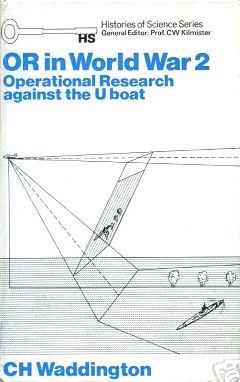
(The O.R. pioneers had been asked to try an improve the success of depth charges used against enemy submarines. The main numerical control in a depth charge is the depth at which the explosive is triggered, by the pressure of water. Until O.R. was brought in, the calculations assumed that a submarine dived immediately at the time it was sighted by the approaching aircraft. Therefore the depth was set at about 150 feet. The O.R. team convinced the military that the deth should be set much less, since submarines did not dive as quickly as had been assumed, and the accuracy of the aircraft was greater for a submarine that remained visible for longer. Suffice it to say that the "success" rate increased. This is pictured on the cover of an out-of-print book.)

I was reminded of this story last week when I noticed a copy of a book about the WW2 battle against U-boats for sale as an unwanted book in the city library. It was written from the point of view of a naval historian, and I spent a few minutes looking to see whether there was any mention of O.R. and its place. Yes, O.R. was mentioned in two places. The first retold the story of the depth charges. The second was non-mathematical. It was the psychology of spotting an aircraft. And the O.R. group were credited with the idea that the underside of the attacking aircraft should be painted white, which would camouflage them against the sky. The O.R. people analysed the results afterwards and demonstrated that this simple measure increased the success rate by a further 30%.

Reflecting on these stories over the last few days, I wondered about two aspects of these stories.

First, how much do we encourage our fellow O.R. scientists to think about psychology and human behaviour?

Second, what are the stories of O.R. success that we can use to enthuse the next generation of O.R. people?

(In the latter context, I have used the success of airline O.R. groups in rescheduling U.S. flights after the atrocities of 9/11, and the role of O.R. in scheduling public transport for the Olympic Games in Beijing.)

Wednesday, 20 August 2008

O.R. and the Infrastructure (3)

Another thought about the hidden science. In the U.K. (and I guess in many other countries) most traffic lights (whatever you call them) at road junctions are controlled by computer. Detectors are located close to the stop line and also in advance of that line, indicating the presence of vehicles waiting and approaching. (Next time you are cycling or walking past traffic lights, have a look for black tar-covered lines in the tarmacadam, which cover detector wires, or look for miniature radar sets on the lights themselves.) The logic behind the programs that control the lights is developed by O.R. scientists. In the programme about infrastructure "Britain from Above", the presenter visited a traffic control room, where the staff had the power to change lights when their traffic monitoring equipment (including TV cameras) detected congestion. It was left unsaid that most of the time the traffic flow is controlled automatically; the people in the control room had to deal with the exceptions, the unusual. Why can't the computer control be extended to cover these exceptions? Cost and complexity. It would cost too much to build in rules for exceptional cases, which would be complex. It is good O.R. (IMHO) to know when to stop building too complex a model. Besides, traffic control has multiple objectives, and the importance of the different objectives changes with the time of the day and much else.

O.R. and the Infrastructure (2)

I'm sure that I shall return to the expression that "O.R. is the hidden science" many times. In the T.V. presentation of "Britain from Above" already mentioned, the presenter observed part of the distribution chain that supplies shops and (especially) supermarkets. In a throwaway remark, he mentioned the 15-minute time windows for collections and deliveries at many stores. And these are part of the world of the O.R. scientist. There have been numerous papers on vehicle routing, and many software companies employ O.R. staff to provide tools for scheduling vehicles with time windows. It is a testimony to the success of O.R. that these hidden tools work, and so everyone can take them for granted! Yes, even the best systems can go wrong, but when was the last time that you couldn't buy an everyday item of food in your local supermarket?