The current issue of the magazine "Mathematics Today" (vol 47, no 3, dated June 2011) includes an article Critical Masses of Research Groups in the Mathematical Sciences
in which the authors (Ralph Kenna and Bertrand Berche) have analysed the research ratings of academic groups in the United Kingdom, as recorded in the Research Assessment Exercise of 2008 (RAE2008). It is based on more extensive work that they have published (Critical mass and the dependency of research quality on group size).
In summary, the authors plotted the outcome of RAE2008 (measured as a quality between 0 and 100) against the size of the research group that reported to RAE2008. This yielded scatter diagrams, which can be interpreted as being piecewise linear, with no, one or two "knees" or breakpoints where the slope changes. Small groups get small scores, and the score increases rapidly as the group size increases. At a critical size, the slope is reduced, and the score increases more slowly. A second "knee" means that the slope is reduced still further, almost to flatness.
The interpretation of the "knees" is that they represent critical sizes for research groups. The lower one is the smallest viable size; less than this, and the quality of the research falls sharply. The upper one represents an upper limit, beyond which adding extra researchers will not add to the quality of the output.
Having said that, the authors report that in pure mathematics, the lower critical mass is at most 2, and the upper one is at most 4. For applied maths, the figures are 6 and 13.
But for statistics and O.R., the critical sizes are 9 and 18. In other words, to produce good academic output, O.R. scientists and statisticians need to be in a large group. Our work makes us gregarious; we work well with other people around us. Since I read the article, I have wondered why this should be, and concluded that it is in the nature of academics in these disciplines that they work together well, they have complementary skills, and those skills are heterogeneous, and they like to collaborate in teams. It chimed with my experience and observations. At various times I have been in groups of between 9 and 18, where we worked well together, and the interplay of ideas flowed. I have also been in a smaller group, and then there was much less academic stimulation. One might think that this would also be true of applied mathematicians, but I suspect that they are more homogeneous in academic expertise than those in stats/O.R.. And the pure mathematics area is much more dependent on individuals with their ideas and theories than those who work with mathematical models and statistical data. (Pure mathematicians -- I love you a lot! -- but you will probably admit to flying solo much of the time.)
Many years ago, I found a spoof paper which was written by M.V.Wilkes under the pseudonym H.W.O.Petard on the optimum size of an establishment. It argues that time gets wasted by people reporting to one another ....
Showing posts with label operational research. Show all posts
Showing posts with label operational research. Show all posts
Tuesday, 7 June 2011

Friday, 3 December 2010
OR and the holidays
This blog post contributes to the INFORMS monthly blogging theme. Look for the INFORMS blog to summarize the blogs at the end of the month.
I have two younger brothers, and we all have families. Choosing where to meet, when to meet and what to do for a Christmas family get-together is a multi-criteria decision problem, and our conclusions demonstrate that solutions to a repeated problem change with time as circumstances alter.
One brother (Michael) lives near Leicester, one (Andrew) near Gatwick, and we live in Exeter. For simplicity, these may be regarded as the vertices of a triangle, sides 4 hours, 5 hours and 3 to 4 hours (depending on the traffic around London).
In the old days it was easy. We all met at my parents' home, which was reasonably central. All that was needed was to schedule who travelled when, and help mum with the catering, cleaning and beds. It wasn't too hard to plan what to do.
Even when mum died, we continued to gather at the same place, but we needed to plan a great deal more for the catering.
Then dad came and lived with us, and people came here; with a smaller house than the parents' home, we needed to arrange that Andrew and Michael would overlap for lunch on the day that one arrived and the other departed.
But when dad died, we all felt that there were better times of the year to visit one another. Tourist attractions are generally closed in December, and that limits the scope for days out. So the problem became more interesting. Meanwhile, the next generation was growing up, which brought other people's criteria into the decision process.
We reached a conclusion that we did not need to meet in December, and for several years got together for a Saturday in January, when it was cheaper to travel by public transport, and there were places we could visit together or things we could do together. So that gave a feasible solution, which ticked several boxes for all of us: ease of travel (we each made a train journey with at most one change of trains), a warm place to meet with space for presents to be exchanged, an activity which was pleasant. There was one surprising downside; the presents that we gave had to be compact and portable as we would be carrying them all day.
Then there was a birth and activities which involved theatre or shows in London became infeasible. One year we strolled in London with a toddler, and fortunately the weather wsa good. We all saw parts of the capital which were new, so it was a memorable meeting.
Another birth meant a baby and toddler to be entertained, along with two twenty-somethings who might or might not be around in January, but were more likely to be available in the week between Christmas Day and the New Year. So the weight attached to different criteria changed. We fed our locations into a website (rendeznew) which told us that the meeting point in the centre of the three homes was near Swindon. So we searched for a suitable place to meet and eat there, hopefully with space for the restless children.
And that is the solution at present. Soon after Christmas, three cars (loaded with people and presents) will congregate on a gastropub near Swindon. Each of us will have a two to three hour drive each way, and we have told the staff that it is a family gathering. We are trying out a third pub, for variety.
Could all this be automated? As I have explained, there have been changes in our needs and hence on the emphasis on different criteria. The web site wasn't really needed, as we could see from a map that Swindon was reasonably central, and we had the knowledge of the UK road system to guide us. Once we had found the right locale, we could have searched for places to eat, by specifying criteria (must have car park, serve vegetarian food, be child friendly) but these would be binary constraints (yes/no) and we might want to treat them as slightly soft constraints.
Sometime, I may return to the algorithm used in rendeznew, which has interetsing O.R. aspects.
An astute reader may spot that there is one constraint which we have implicitly included. Nobody wants to stay in a hotel for the family get together.
Monday, 15 November 2010
Qantas rescheduling
After a recent "incident" in which an A380 airbus had to abort its flight, all the company's wide-bodied jets have been withdrawn. How does an airline deal with the the knock-on effect of this? They reschedule their flights and passengers. And, we, the public, see the results. Rescheduling has involved the downsizing of aircraft across all Qantas international routes.
That's the public picture; behind this there must have been some complex modelling, which will be kept restricted. Maybe one day, some Qantas O.R. worker will tell us about the models that were hastily built and modified. If you have been involved with a large O.R. problem, then you can imagine what is involved. To replace aircraft A on flight A1 means substituting aircraft B. How many passengers will be lost? What will it cost? But aircraft B was assigned to flight B1 and needs to have a substitute, aircraft C. And so on. Then, the speeds of A, B and C are likely to be different, so there are further consequences.
Which passengers should be bumped? There will be data on the flying habits of the passengers, which can be used to help this. I suspect that the O.R. people at Qantas are busy doing their hidden science!
Flagship routes to Los Angeles and London from Australia, usually operated by the super-jumbos, will now use older and smaller Boeing 747s, as will all other A380 flights. 100 passengers per flight who were bumped off have been transferred to other airlines.
The downsizing of shorter flights will continue with Boeing 747 flights to Hong Kong and Tokyo now using Airbus 330s, replaced on their normal routes such as Singapore to Perth with even older Boeing 767s. According to the airline, although it is committed to bringing its A380s back into service as early as possible, the new schedules give certainty to those travelling in the near future.
As the Qantas grounding drags on, fares on certain routes have been increased.That's the public picture; behind this there must have been some complex modelling, which will be kept restricted. Maybe one day, some Qantas O.R. worker will tell us about the models that were hastily built and modified. If you have been involved with a large O.R. problem, then you can imagine what is involved. To replace aircraft A on flight A1 means substituting aircraft B. How many passengers will be lost? What will it cost? But aircraft B was assigned to flight B1 and needs to have a substitute, aircraft C. And so on. Then, the speeds of A, B and C are likely to be different, so there are further consequences.
Which passengers should be bumped? There will be data on the flying habits of the passengers, which can be used to help this. I suspect that the O.R. people at Qantas are busy doing their hidden science!
Wednesday, 28 April 2010
Marshmallow towers
I wish that I had more time to look at some of the amazing/fascinating talks at TED (www.ted.com). I came across Tom Wujec's short talk about his "Build a marshmallow tower" this week (Thank you to Boing Boing.)
http://www.ted.com/talks/tom_wujec_build_a_tower.html
Among the lessons from the research are that successful projects need organising, they need specialist expertise, and that there is great value in iteration, testing and improving. (Note the success of groups with someone with organisational skills, the work of architects, the kindergarten students.)
These lessons apply to O.R. projects as well.
(1) Time spent planning is seldom wasted;
(2) O.R. is not just about techniques; there needs to be experience of project work provided by a broad exposure to O.R. work
(3) the process of O.R. model-building ought to be iterative, with feedback from simple models feeding the refinement of the next development of that model.
Monday, 24 August 2009
More about psychology
It is salutary to remember that the second world war, which had such an influence on my childhood, is now studied as "history" at schools. Although I was born several years afterwards, the war was sufficiently recent to affect me in various ways. Added to the change in "distance" is the change in technology and communication.
It was natural for my training in O.R. to begin with a little of the background to O.R. from WW2; we were all peers, in the sense that we had grown up with family experiences from parents and relatives of the horrors of that conflict. And our lecturers on the postgraduate O.R. programme had either experienced the pioneering wartime years of O.R., or had been mentored by those who had been involved. One of the first case-studies we heard about was the classic of "O.R. against the U-boat".
(The O.R. pioneers had been asked to try an improve the success of depth charges used against enemy submarines. The main numerical control in a depth charge is the depth at which the explosive is triggered, by the pressure of water. Until O.R. was brought in, the calculations assumed that a submarine dived immediately at the time it was sighted by the approaching aircraft. Therefore the depth was set at about 150 feet. The O.R. team convinced the military that the deth should be set much less, since submarines did not dive as quickly as had been assumed, and the accuracy of the aircraft was greater for a submarine that remained visible for longer. Suffice it to say that the "success" rate increased. This is pictured on the cover of an out-of-print book.)
I was reminded of this story last week when I noticed a copy of a book about the WW2 battle against U-boats for sale as an unwanted book in the city library. It was written from the point of view of a naval historian, and I spent a few minutes looking to see whether there was any mention of O.R. and its place. Yes, O.R. was mentioned in two places. The first retold the story of the depth charges. The second was non-mathematical. It was the psychology of spotting an aircraft. And the O.R. group were credited with the idea that the underside of the attacking aircraft should be painted white, which would camouflage them against the sky. The O.R. people analysed the results afterwards and demonstrated that this simple measure increased the success rate by a further 30%.
Reflecting on these stories over the last few days, I wondered about two aspects of these stories.
First, how much do we encourage our fellow O.R. scientists to think about psychology and human behaviour?
Second, what are the stories of O.R. success that we can use to enthuse the next generation of O.R. people?
(In the latter context, I have used the success of airline O.R. groups in rescheduling U.S. flights after the atrocities of 9/11, and the role of O.R. in scheduling public transport for the Olympic Games in Beijing.)
It was natural for my training in O.R. to begin with a little of the background to O.R. from WW2; we were all peers, in the sense that we had grown up with family experiences from parents and relatives of the horrors of that conflict. And our lecturers on the postgraduate O.R. programme had either experienced the pioneering wartime years of O.R., or had been mentored by those who had been involved. One of the first case-studies we heard about was the classic of "O.R. against the U-boat".
(The O.R. pioneers had been asked to try an improve the success of depth charges used against enemy submarines. The main numerical control in a depth charge is the depth at which the explosive is triggered, by the pressure of water. Until O.R. was brought in, the calculations assumed that a submarine dived immediately at the time it was sighted by the approaching aircraft. Therefore the depth was set at about 150 feet. The O.R. team convinced the military that the deth should be set much less, since submarines did not dive as quickly as had been assumed, and the accuracy of the aircraft was greater for a submarine that remained visible for longer. Suffice it to say that the "success" rate increased. This is pictured on the cover of an out-of-print book.)
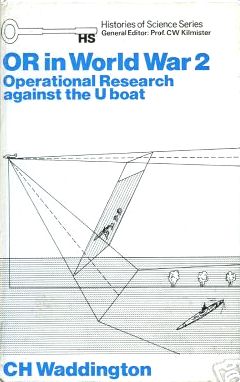
I was reminded of this story last week when I noticed a copy of a book about the WW2 battle against U-boats for sale as an unwanted book in the city library. It was written from the point of view of a naval historian, and I spent a few minutes looking to see whether there was any mention of O.R. and its place. Yes, O.R. was mentioned in two places. The first retold the story of the depth charges. The second was non-mathematical. It was the psychology of spotting an aircraft. And the O.R. group were credited with the idea that the underside of the attacking aircraft should be painted white, which would camouflage them against the sky. The O.R. people analysed the results afterwards and demonstrated that this simple measure increased the success rate by a further 30%.
Reflecting on these stories over the last few days, I wondered about two aspects of these stories.
First, how much do we encourage our fellow O.R. scientists to think about psychology and human behaviour?
Second, what are the stories of O.R. success that we can use to enthuse the next generation of O.R. people?
(In the latter context, I have used the success of airline O.R. groups in rescheduling U.S. flights after the atrocities of 9/11, and the role of O.R. in scheduling public transport for the Olympic Games in Beijing.)
Monday, 17 August 2009
OR Insight
I have just received the latest (September 2009, 22:3) issue of the journal OR Insight, one of the OR Society's regular publications. I'm interested because it has an article that I wrote, the first which has appeared in this journal.
OR Insight aims to promote Operational Research in action, with a serious emphasis on the application area. Since the start of the year, a new editorial team has been in charge and they have been determined to get good quality reports of the nature of modelling and tackling problems with OR. (So why did my paper get in!)
My paper discusses the phenomenon of "Open Studios" as a means of promoting the creative arts in the UK and elsewhere. I tackled it from an OR perspective, and as such I think it is the first paper in the area. I wrote for OR Insight because I wanted to tell a story, and this seemed the best journal for that type of paper.
But there are three other excellent papers, each telling a story of a study and the modelling which went with it.
The first considers one of the difficulties of modern life - home deliveries from mail order companies and similar. If you are out when the delivery van arrives, what happens to your package? Fraser McLeod and Tom Cherrett model one option, that customers should go to a central collection point; they look at the environmental impact of that scenario.
The second looks at health care provision of transport. The perspective is focussed on the patient (in contrast to the the apparent manager-centred perspctive often met in OR studies). The authors (David Bamford, Helen Thornton and James Bamford) conclude with two penetrating questions: "What went well?"; "What could we have done better?" Maybe those should be asked at the end of more OR studies!
And the third, by Gary Graham and John Hill, looks at the regional newspaper industry in the 21st century, and the relationship between print and electronic media. The internet is creating value for the newspaper industry, even though sales of regional newspapers are falling slowly in the UK.
Go get a copy!
Monday, 20 April 2009
Lessons for O.R. from the primary school
The same article in "The Independent" mentioned the primary school at St Ives; there was a thought-provoking quote from its head teacher (Joanne Dean) too. She too stressed the need for lifelong learning for everyone (including the O.R. profession!).
We never think to ourselves:
"That's it; I have learnt all I need to know."
It never happens
We never think to ourselves:
"That's it; I have learnt all I need to know."
It never happens
Lessons for O.R. from the junior school
Britain's "The Independent" daily paper carries a supplement on education most weeks. Last Thursday (16th April) there was a page about two schools in St Ives, Cornwall. Although St Ives is a popular holiday destination, many local people are not well off, as tourism is low paid, seasonal work. The Junior School had problems when it was inspected in about 2003, and the head teacher, Sue Smith (no relation) was drafted in to sort things out. The feature covered many of her achievements and philosophy.
Two quotes struck me as being relevant to the O.R. profession. First, a homily from her office wall:
In times of change, the learners will inherit the earth whilst the knowers will be beautifully equipped to deal with a world which no longer exists.
Second, the response to Sue Smith's question at the start of school assembly, "What are we doing?":
We are thinking, looking, listening, not talking, and concentrating.
Why the relevance to O.R.? For the first one, it is a reminder that learning never stops; as O.R. professionals, we are agents of change in systems, and that rebounds on us -- we need to be people who learn and change in turn. And for the second, those five characteristics should be the ones we show when we face a new management problem; maybe the fourth is not so relevant, and might be replaced by "Not talking irrelevantly".
Monday, 2 March 2009
Designing road markings
I am someone who frequently asks the question "Why?" about the design of everyday objects, because of the interplay between design and operational research. On my way to the office today, I noticed that one of the advanced stop lines for cyclists seemed much larger than others that I encounter. So I asked myself "Why is it that size?" and then speculated about the optimal size for such a road marking.
The wonders of Google led me to a website from the UK Department for Transport, which says that the "cycle reservoir should be between 4m and 5m in depth. If the reservoir is shallower than this cyclists can feel intimidated by the close proximity of the vehicles queuing behind them. If the reservoir is deeper than this, motorists may feel encouraged to encroach into it." So the design is based on psychology, which links to some of my earlier blogs here. It is reassuring that someone has thought about the design and suggested guideline measurements.
So if you see me around Exeter with a 4metre tape measure, you will know that I am checking the roads!
Tuesday, 3 February 2009
Optimising the sub-system or the system?

There was heavy snow in Southern England yesterday, and there were problems with the transport infrastructure. In London, all the buses were cancelled, flights were cancelled, trains delayed, roads congested and blocked by accidents. Inevitably, some people asked the question "Why?". "Why can other countries cope with heavy snow, while England cannot?"
"Why?" is, of course, the correct question for an O.R. analyst to ask. And, I am pleased to note, there were people prepapred to give an O.R. answer. It comes down to the words of today's title. Should one optimise the system or the sub-system? For the commuter whose journey has been disrupted, the sub-system is non-optimal because he or she believes that the optimal solution is for there to be no problems with the commuter's journey. But the speaker explained that optimising the system means that it is not economic to have expensive equipment and trained staff needed for one or two days every ten years. It was a matter of costs and benefits. Naturally, the speaker didn't use these words, but they were implicit. And then the speaker added that with increasing numbers of people able to work from home, the difference between optimising the system and optimising the sub-system became even greater.
The picture is of my back garden this morning.
Monday, 19 January 2009
Marketing and Operational Research
My impressions are that in the United Kingdom, surprisingly few O.R. scientists have published papers relating to marketing. The U.S. O.R. society, INFORMS, publishes a journal devoted to quantitative marketing, but there is no comparable interest in the U.K.. Over the years, I have had one or two encounters with projects relating to some aspect of marketing, but have never got a sense that marketing departments use O.R. advice very much. Some of the projects have started with the adage "Half the money spent on advertising is wasted -- but nobody knows which half; if you knew which half, you would make a fortune."
In my postgraduate course we came across a problem which I have never seen written up, perhaps because the problem was trying to build a model to explain some anomalous data and the parameters would have been a commercial secret. So here, nearly forty years after it happened, is a summary.
For many years, the dominant company in the U.K. market for potato crisps was "Smith's". They held over half the market. Then a new bran d was launched, called Golden Wonder. Over the subsequent few months, surveys were carried out to try to measure brand awareness. The problem was that the percentage answering the question "What was the brand of crisps that you last bought?" with "GW" was far lower than the percentage market share for GW. Why?
The answer was inertia and lack of awareness of the brand. Purchasers would ask for a "packet of crisps" and since most shops (and especially bars) only stocked one brand of an item that occupied a lot of storage space, the purchasers accepted what they were given and did not associate their purchase with a brand -- and Smith's had been the leading brand for so long that the association was "Smithscrisps" as one word.
So, as students, we were asked to re-work what the consultants had done, and build a model to link the growth over time of the sales and the growth over time of the awareness. It taught us about building and fitting nonlinear models, and a little about the vagaries of our fellow humans. But it could never have been written up as a paper!
In my postgraduate course we came across a problem which I have never seen written up, perhaps because the problem was trying to build a model to explain some anomalous data and the parameters would have been a commercial secret. So here, nearly forty years after it happened, is a summary.
For many years, the dominant company in the U.K. market for potato crisps was "Smith's". They held over half the market. Then a new bran
 d was launched, called Golden Wonder. Over the subsequent few months, surveys were carried out to try to measure brand awareness. The problem was that the percentage answering the question "What was the brand of crisps that you last bought?" with "GW" was far lower than the percentage market share for GW. Why?
The answer was inertia and lack of awareness of the brand. Purchasers would ask for a "packet of crisps" and since most shops (and especially bars) only stocked one brand of an item that occupied a lot of storage space, the purchasers accepted what they were given and did not associate their purchase with a brand -- and Smith's had been the leading brand for so long that the association was "Smithscrisps" as one word.
So, as students, we were asked to re-work what the consultants had done, and build a model to link the growth over time of the sales and the growth over time of the awareness. It taught us about building and fitting nonlinear models, and a little about the vagaries of our fellow humans. But it could never have been written up as a paper!
Monday, 1 December 2008
Genchi Genbutsu
Genchi Genbutsu is a new expression for me. It was posted in a discussion board, as relevant experience for anyone in O.R.. The wikipedia summary is:
Genchi Genbutsu (現地現物) means "go and see for yourself" and it is an integral part of the Toyota Production System. It refers to the fact that any information about a process will be simplified and abstracted from its context when reported. This has often been one of the key reasons why solutions designed away from the process seem inappropriate.
I don't know why there is so little literature drawing on the parallels between Genchi Genbutsu and practical O.R.; good O.R. requires the modeller to understand what is happening in practice, and you do not learn that by sitting in an office. I suppose that there are eqivalent expressions in English -- "go and see for yourself", "management by walking around", "walk the line". But too many managers (and a few O.R. people) rely on second-hand information.
Tuesday, 25 November 2008
Defining O.R.
The journal that I edit, International Abstracts in O.R. (IAOR), aims to index and abstract the worldwide academic literature of O.R. and Management Science. This means that I (and others) need to make binary decisions about papers; is this one "O.R/M.S." or not?
So what rules to follow? I have several. There are about 40 journals which are abstracted cover-to-cover. These are the journals published by one or more national O.R. societies, such as Operations Research, Management Science, Journal of the Operational Research Society, 4OR and ORiON. There are others which are clearly primary journals in O.R. such as Omega and Health Care Management Science Dealing with these is, so to speak, easy. Then there are about a hundred which regularly include O.R. related papers. Then, I have a long list of journals which have, at one time or another, provided one or more abstracts for IAOR. Some of these abstracts have been found by serendipity, others by researchers citing them in papers in the principal journals. But I need to decide that binary question in each case; is this O.R.? I look at the content (as described in the title and the abstract). As I do, I ask myself what the paper is about. If it is a paper about theory, is the theory directly concerned with a modelling tool (not, I stress, necessarily a mathematical tool) from the suite of techniques used in O.R.. If so, I say yes. If the theory is less directly relevant, I speculate about whether it is close to a technique that is used in O.R.. Practical papers are considered with the question: is this about a decision-making problem? Is there something that a decision-maker could learn from? Is this paper about a problem in practice where I would expect an O.R. person to be involved?
These may appear naive heuristics, but they work. And in my reading, I can add further questions. When I taught in a unit devoted to statistics and operational research, I often used the (crude) distinction that statistics was concerned with looking at what had happened, and O.R. with modelling what might happen, to answer the questions "What if?" and/or "What's best?"
There are still fuzzy edges, at the interfaces with other disciplines. Engineering problems, economic models, psychology of decision-making ... all pose classification uncertainties. But all of these point to the universality of O.R. in the world today.
Monday, 10 November 2008
Wjat went wrong at T5?
Mention "Terminal 5" to an air traveller this year and you may well be greeted by a hollow laugh. The new terminal at Heathrow gummed up within a couple of hours of opening. The summary report states that:
"On the first day of operation alone, 36,584 passengers were frustrated by the 'Heathrow hassle' that Terminal 5 had been designed to eliminate." More than 600 flights were cancelled in the first 11 days, and "23,205 bags required manual sorting before being returned to their owners". The causes: "Insufficient communication between owner (BAA) and operator (British Airways, or BA), and poor staff training and system testing".
All this sounds strange, because the airline BA has one of the most efficient O.R. teams in the United Kingdom. (Yes I mean it, and am not hoping for freebies.) But the word "communication" is at the core of the problem, as a short extract from what Iggy Vaid (a shop steward for staff working on T5) said in an appraisal of the mess:
"I hate to say that about my own airline, but culturally the existing management structure is one where you cannot tell the emperor that he has no clothes; you have to say his clothes are beautiful. No supervisor or person can tell his or her boss that the system will not work. If you do you are not a team player; you are sidelined, so for that reason you say that it works and the emperor has beautiful clothes."
Even the most efficient O.R. work will not be successful if there is no way to communicate it.
Later in the report from which I am quoting (The Independent, Saturday 10th November 2008) another area of potential (inevitable) breakdown was highlighted:
"Should there be a failure in the system at any point it will not self-rectify."
Hidden in these words is a warning for every large O.R. project
Tuesday, 28 October 2008
Operational Reesearch and the urban cyclist
I am committed to cycling as a sensible means of transport, even though my own cycling has not been completely accident-free. The other day I was musing on whether there is much literature about O.R. and cycling. And then I heard about eBourbaki, which describes itself as "a mathematical problem-solving company" (no mention of O.R.!) and the competition that had been run to model cycle-hire facilities in London. Readers of "OR/MS Today" will have seen that one of the political conventions modeled the location of cycle-loan facilities in 2008. eBourbaki run their problems as competitions, and the winners created two mathematical models with one describing commuter flow and the other examining the possible configuration of any bicycle stations.
It is to be hoped that the city will work with the winners and consider using their solutions and models in the network design.
The models suggested that, for a London-based scheme to be successful, 12 large bicycle stations should be placed near railway stations in central London with 250 smaller stations distributed throughout the West End and the City of London. An average of 20 bikes per small station was found to be the most efficient number.
Tuesday, 16 September 2008
Operational Research and Psychology
Well, actually, as many people have pointed out in the past, psychology is part of O.R., so my title creates a false split.
A part of my education in O.R. was the apocryphal story about the O.R. consultants and the problem of the lifts in the skyscraper. Occupants of the building complained about the time they spent waiting for the lifts to get from the upper floors to the lobby. So the consultants looked at the options, they built models of the consequences of extra lifts, faster lifts, dedicated lifts from the upper floors, etc., etc. The reduction in mean waiting time was always very small. Then the psychologist in the team suggested that the company place mirrors in the waiting areas for each lift shaft. He explained why. Why? (see the end of this blog)
I had the same sort of problem at the weekend. Each year, on the second Saturday in September, I take part in a prayer walk around the churches of the city of Exeter, my home. The idea is that a group will start early in the morning, follow a winding route around the city, stopping to pray in about 25 different churches, praying for the city and its people. I have the responsibility of planning the route; for several years we have used the same route. This is not a TSP, of course, because the walkers don't end at the start point. It is not quite minimal but is quite close to the best.
In 2008, two new churches came into the list of city churches. We decided to include one of them, miss the other, and omit another, because it was linked strongly with these two. But the selected new church would add so much extra mileage to the old route that we needed a new plan. So we made the walk have two starts, with two groups starting at 8am and converging on the cathedral at 10am to walk for the rest of the day together. So I devised such a route; the two initial legs had minimal lengths for the churches that they visited, given the fixed end at 10am. However, I had forgotten the psychology. The second route had a lot of road walking, and went past the main railway station, so there was traffic. The consensus was that it would be better to walk a little further (about 300 to 400 metres) and walk beside the river on a footpath, away from the traffic. So that is what we will probably do next year -- alter the start and route to give more traffic-free paths.
Why the mirrors? The reason was that it was not the actual waiting time that people notices, but the perceived waste of time. Mirrors distracted people; some could admire themselves and tidy their clothes and appearance, others could watch. (In the 1970's there were sexist stereotypes for these activities, which I will not repeat.)
Wednesday, 10 September 2008
Education and brains
"To repeat what others have said, requires education; to challenge it, requires brains."
Mary Pettibone Poole, A Glass Eye at a Keyhole, 1938
I had not come across this thought-provoking quotation until yesterday; then I was in a meeting and found it inscribed on the wall of the small conference room. Yes, it has O.R. applications. Part of the skill in the O.R. scientist should be (must be?) the ability to recognise where a model developed earlier in a different context might apply to a practical problem. So queue theory is used for call centres and for slow moving inventories. Location theory applies to ATM outlets and airports. But sometimes the obvious is not appropriate -- then the O.R. scientist needs brains to challenge the obvious.
Wikipedia doesn't tell me anything about the author or the book. And I wonder who has used their brains and challenged Mary's words, rather than repeat them?
Operational Research and Christianity
I recently read that the educational background of the Bishop Sarah Frances Davis in the African Methodist Episcopal church has a degree in Management Science. Can O.R./M.S. help in such a role? In IAOR, there are several papers recorded which refer to applications of O.R. in the life of the church. In the 1970's and 80's, Malcolm King, Alan Mercer and I published some papers about the place of modelling in the deployment of clergy in the U.K.
[Malcolm King, David K. Smith and Alan Mercer "Towards Diocesan Planning" Journal of the Operational Research Society 29 p856-866 (1978); Malcolm King and David K. Smith "Are the Clergy Being Deployed Fairly?" The Churchman 5 p54-60 (1980); Malcolm King and David K. Smith "Planning the Deployment of Clergy" Long Range Planning 5 p104-111 (1982)]
Earlier, Alan had published "The Churching of Urban England" in the proceedings of the 1969 IFORS conference, which looked at the location of places of worship.
So there are two possible areas for fruitful O.R.; manpower planning, and location models.
I wonder if Bishop Davis knows about this work.
Monday, 1 September 2008
The Numerati by Stephen Baker
Also in the INFORMS enews:
Business Week reporter Stephen Baker, has written The Numerati, which describes the superpowered contributions that mathematicians-and operations researchers-are making to businesses and organizations today. Publishers Weekly has given advance praise, calling The Numerati a "captivating exploration" about "a new breed of entrepreneurial mathematicians." Houghton Mifflin is publishing the book this fall (autumn if you live in the United Kingdom).
There is a video of an interview with the author here.
Blogging on O.R.
In the INFORMS enews, there was this note:
Some of INFORMS' most enthusiastic members are blogging about O.R., operations management, engineering, and science. Have you visited their blogs yet?
Former INFORMS President Michael Trick of Carnegie Mellon University, who currently serves on the INFORMS Public Information Committee (PIC), blogs from conferences and shares fresh news about O.R. Michael Trick's Operations Research Blog.
Fellow PIC member Aurélie Thiele of Lehigh University shares her views at Thoughts on Business, Engineering, and Higher Education.
Wharton Professor Gerard Cachon, the current editor of M&SOM and the incoming editor of Management Science, blogs on operations management at Matching Supply with Demand.
Visit these blogs, catch up on news and views, and share your own O.R. perspectives. Know about more O.R. blogs? Let us know by sending an email to barry.list@informs.org.
To which we can add this blog, and that of Laura McLay (Punk Rock Operations Research)
Subscribe to:
Posts (Atom)