Showing posts with label railways. Show all posts

Monday, 13 September 2010

Fair Exchange in 1948

In 1948, the railways in the United Kingdom were nationalised by the then government. There were four (the "Big Four") railway companies operating in the country, and they acted independently of each other for many purposes. So, after nationalisation, British Railways had a fleet of steam engines from four different stables. Because of the war, many of these locomotives were past their best. Each of the companies had its own locomotive designers, and over the years, each company had developed its own style of locomotive design, to meet the topography of the region, and the objectives of its railway service.

The new management realised that this might be inefficient, so commissioned trials to help find a range of standard steam locomotives. So they mixed and matched, taking locomotives from one stable and running them on the other types of track. The aim was to find the "best".

Now, one of the first questions one asks in O.R. is "What do you mean by best?" According to the history of the 1948 Exchange, nobody really thought of this. Obviously it is a multi-criteria problem, and there are several types of locomotive to be identified and designed. But, even for one type, such as hauling express trains, there are various criteria to consider. The Wikipedia article about the exchange comments:
the testing had little scientific rigour, and political influence meant that LMS practice was largely followed by the new standard designs regardless.

So the optimum was found, not so much by scientific analysis, but by politics. O.R. scientists, beware!

And a little footnote from the book which started me on this story, Amazing and Extraordinary Railway Facts by Julian Holland:
One eminent railway historian was shocked that the Stanier Black 5 type had performed badly; it appeared that the driver and fireman had tried to minimise the fuel consumption during the trial.

So, of course if your staff don't understand the aim of the experiment, they may interpret it in the wrong way. Beware!
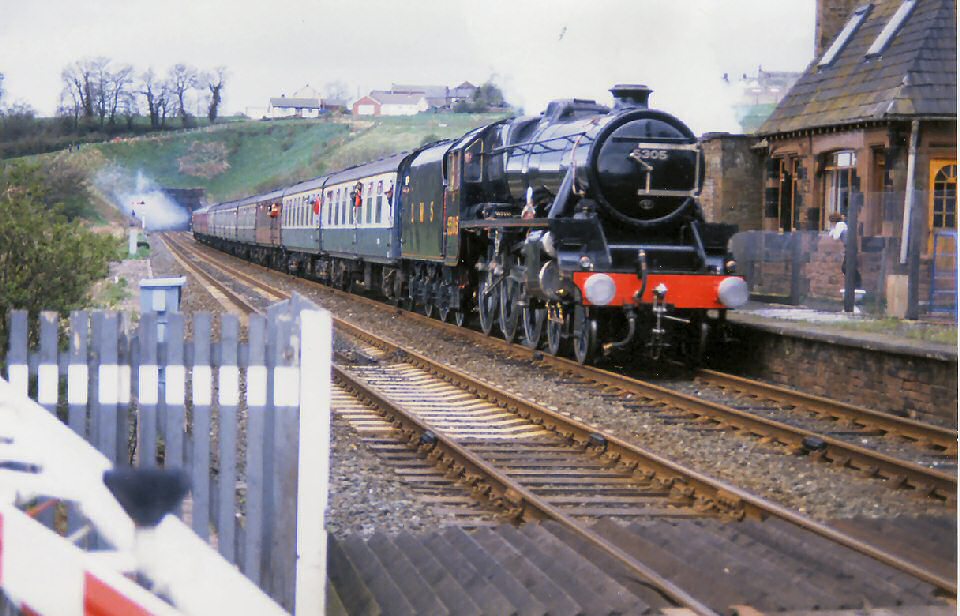


A Stanier Black 5

Monday, 22 June 2009

Railways in the UK

To people in Britain born before -- say -- 1955, the name "Doctor Beeching" automatically conjures up the story of the drastic curtailing of the UK railway network. Following a study of the financial health of the UK railway system, in the early 1960's, Doctor Beeching recommended the closure of many railway branch lines and many stations on the remaining lines. From a network which connected cities, towns and villages, the network became one which connected cities and large towns. The report envisaged rail users commuting to their nearest station by car or public transport, and continuing their journey by rail. Over the years, the Beeching closures have been condemned by many people. Unfortunately, it is very difficult to reverse them; old tracks have been taken up, and the land has reverted to farmland or used for housing. Some stretches of the network have become footpaths and cycleways.

Last week, proposals were published to try and reverse some changes, by reopening lines and reinstating stations. Intriguingly, the proposals were based on a cost-benefit analysis, and the proposals were those which exceeded a threshold for the ratio of costs to benefits. So O.R. was used, at least in the financial model. Two cheers for the report! It would get three cheers, if there was evidence that the compilers had looked at the feasibility of the proposals, asking questions such as the availibility of car-parks for rail users, and whether or not timetables could be adjusted to include the new stations and lines.