One of the standard textbooks in operational research a generation ago was "Fights, Games and Debates" by Anatol Rapoport. Rapoport distinguished between Fights, where you want to overpower your opponent, Games, where you want to outwit your opponent, and Debates, where you want to convince your opponent. Last week our home group Bible study was looking at chapter 25 and I commented that the story there illustrated those three situations.
The fight: in 25v7, When Paul came in, the men who had come down from Jerusalem stood around him. They brought many serious charges against him, but they could not prove them.
The game: in 25v3, They requested Festus, as a favour to them, to have Paul transferred to Jerusalem, for they were preparing an ambush to kill him along the way.
The debate: in 25v8, Then Paul made his defence: “I have done nothing wrong against the Jewish law or against the temple or against Caesar.”
As is clear from the whole chapter, the various parties present were not working to the same agenda, and hence they never communicated with one another.
Showing posts with label history. Show all posts
Showing posts with label history. Show all posts
Friday, 11 February 2011

Monday, 20 December 2010
O.R. and some French roads
I am always intrigued when I find references to some kind of modelling which is identifiable as O.R. in obscure places. A book on the historical geography of France has provided two such observations. ("The Discovery of France" by Graham Robb)
Writing about the mid nineteenth century, "In the Landes, where carriages sank in the sand up to their axles, the engineer Chambrelent calculated that once a road reached a certain length it would be destroyed by the process that built it: 'In travelling to the point where it will be used to prolong the road, one cubic metre of stone or gravel wears out more than one cubic metre of road.'"
The modelling must have been based on some observations and statistical analysis.
Then, about roads later in the nineteenth century, "The chief engineer in the Limousin, Pierre Tresaguet, had insisted that a limit sould be placed on [road] gradients. ... The old road east of Morlaix still includes a needless climb of 15 per cent (1 in 7) because the blundering military Governor of Brittany, the Duc d'Aiguillon, preferred straight lines to the more accommodating curve of the older road that runs alongside. Thanks in part to Tresaguet, it is unusual now to find a climb in excess of 8 per cent (1 in 12). This was thought to be the steepest gradient that a fully laden mule could manage. British mountain roads seem to rise in fits and starts like step pyramids. French mountain roads go much higher, but more steadily, and can comfortably be climbed for hours by a fully laden cyclist."
So far so good; the road builders were given a constraint which had been thought about in terms of the users of the road. But there's a twist in the footnote to these comments, indicating that other people didn't make observations:
"To judge by the army handbook of 1884, it is fortunate that most road building was left to civil engineers:
Gradient on which troops can still march in good order: 25 per cent;
Gradient manageable by mounted horses and light carriages: 33 per cent;
Gradient manageable by mules: 50 per cent;
Escarpment that an infantryman can still cross by using his hands: 100 per cent (completely vertical)"
Writing about the mid nineteenth century, "In the Landes, where carriages sank in the sand up to their axles, the engineer Chambrelent calculated that once a road reached a certain length it would be destroyed by the process that built it: 'In travelling to the point where it will be used to prolong the road, one cubic metre of stone or gravel wears out more than one cubic metre of road.'"
The modelling must have been based on some observations and statistical analysis.
Then, about roads later in the nineteenth century, "The chief engineer in the Limousin, Pierre Tresaguet, had insisted that a limit sould be placed on [road] gradients. ... The old road east of Morlaix still includes a needless climb of 15 per cent (1 in 7) because the blundering military Governor of Brittany, the Duc d'Aiguillon, preferred straight lines to the more accommodating curve of the older road that runs alongside. Thanks in part to Tresaguet, it is unusual now to find a climb in excess of 8 per cent (1 in 12). This was thought to be the steepest gradient that a fully laden mule could manage. British mountain roads seem to rise in fits and starts like step pyramids. French mountain roads go much higher, but more steadily, and can comfortably be climbed for hours by a fully laden cyclist."
So far so good; the road builders were given a constraint which had been thought about in terms of the users of the road. But there's a twist in the footnote to these comments, indicating that other people didn't make observations:
"To judge by the army handbook of 1884, it is fortunate that most road building was left to civil engineers:
Gradient on which troops can still march in good order: 25 per cent;
Gradient manageable by mounted horses and light carriages: 33 per cent;
Gradient manageable by mules: 50 per cent;
Escarpment that an infantryman can still cross by using his hands: 100 per cent (completely vertical)"
Wednesday, 11 August 2010
Farewell to all that
Today I removed my last possessions from the university campus. Since I retired, I have had the privilege of a little working space on campus, in an office shared with several other active retired staff. I have used it for writing and editorial work, and valued the chance to see and talk with former colleagues.
Alas, that has now come to an end. The office is no longer to be free for the honorary staff, and so I decided to move my last few things home. As I did so, I thought back over the 35 years since I came to Exeter. It is unusual to have spent so much of one's entire working life in one place.
I have had six different offices, in three different buildings.
When I came, the data and programs for my research came with me in two card cabinets, each holding 10000 punched cards. When I left, I needed a USB stick to carry far more data and material. I regret that one of the datasets that was on punched cards has been lost; it can never be replaced, and there was scope for some more statistical analysis to be done on it. Some of the research publications that I had used for my PhD research were on microfiche; that is a medium which has practically disappeared. When I came, I already had a small collection of books and journals that filled about 12ft of shelf space. Even with pruning, I have three times that space for professional material.
When I started, the language of choice for programming was Fortran. That was my fifth language (after Algol 60, Titan Autocode, Basic, CSL). We progressed through Simula, Pascal, C and C++. The first desktop computer we used was a PET, but we never did any research on it. A research grant provided a more substantial machine in 1981 or 82, which used 8inch floppy discs, and compiled a Pascal program in about 20 minutes! Olivetti PCs arrived in 1986, and thereafter most of my computing was based on PCs.
What changes will there be in the next 35 years?
Alas, that has now come to an end. The office is no longer to be free for the honorary staff, and so I decided to move my last few things home. As I did so, I thought back over the 35 years since I came to Exeter. It is unusual to have spent so much of one's entire working life in one place.
I have had six different offices, in three different buildings.
When I came, the data and programs for my research came with me in two card cabinets, each holding 10000 punched cards. When I left, I needed a USB stick to carry far more data and material. I regret that one of the datasets that was on punched cards has been lost; it can never be replaced, and there was scope for some more statistical analysis to be done on it. Some of the research publications that I had used for my PhD research were on microfiche; that is a medium which has practically disappeared. When I came, I already had a small collection of books and journals that filled about 12ft of shelf space. Even with pruning, I have three times that space for professional material.
When I started, the language of choice for programming was Fortran. That was my fifth language (after Algol 60, Titan Autocode, Basic, CSL). We progressed through Simula, Pascal, C and C++. The first desktop computer we used was a PET, but we never did any research on it. A research grant provided a more substantial machine in 1981 or 82, which used 8inch floppy discs, and compiled a Pascal program in about 20 minutes! Olivetti PCs arrived in 1986, and thereafter most of my computing was based on PCs.
What changes will there be in the next 35 years?
Wednesday, 26 May 2010
Genetic algorithms
I am ashamed to admit that I was slow to appreciate the possibilities of genetic algorithms. Way back in the 1980's, pre-internet, my colleague Keith and I were visited by a group of researchers from a local compnay who wanted to set up a project with our OR staff at the university. One of them asked if I had thought of using GAs. At that time, I had never heard of them; it was two or three years later that I next encountered them, and I suspect that if we had known even a little about GAs when the project proposal was being put together, we might have been able to contribute some applications in the literature. Since then, some of my work has used GAs and other meta-heuristics.
I was amused to discover the cartoon in xkcd, which imagines what might happen if food recipes were created using GAs.

It reminded me of other examples of cross-over from GAs to everyday life. Ian Stewart imagined evolution of crosses between cats and birds, with an imaginary landscape of various combinations of cats with wings and birds with paws. There have been several research projects for creating abstract art by GAs, and some of these projects have linked the concept to abstract music as well. Somehow, even if we had caught on to the idea of GAs after that casual conversation, I don't think that I would have gone into computer art!
I was amused to discover the cartoon in xkcd, which imagines what might happen if food recipes were created using GAs.
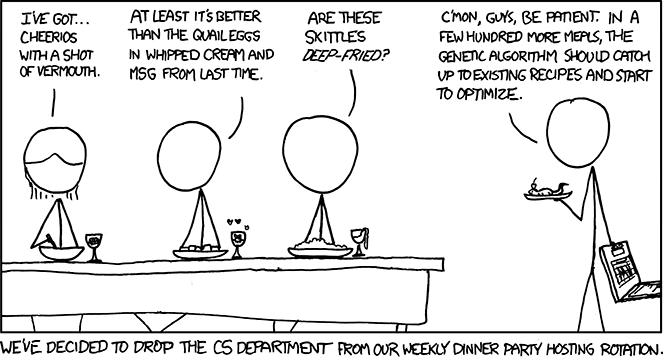
It reminded me of other examples of cross-over from GAs to everyday life. Ian Stewart imagined evolution of crosses between cats and birds, with an imaginary landscape of various combinations of cats with wings and birds with paws. There have been several research projects for creating abstract art by GAs, and some of these projects have linked the concept to abstract music as well. Somehow, even if we had caught on to the idea of GAs after that casual conversation, I don't think that I would have gone into computer art!
Tuesday, 12 January 2010
The Bishop and Wartime O.R.
Earlier this year, Bishop Graham Leonard died. He had been Bishop of Truro (next door to Devon) and then a very distinguished Bishop of London. In his obituary in the "Church Times" there was a one-sentence reference to the fact that during 1944-1945 he had been seconded to the Army O.R. group. No further explanation, and I wondered how many of the readers of the paper would know what O.R. was. A further search led to a national newspaper recording that he had worked on fuses. That led to yet another search using the keywords "Operational Research" and "fuses" which didn't turn up any more about the late bishop.
However, the search turned up a reference that in 1944-45 the Army O.R. group had been working on fuses used against the V2 "flying bombs". And that reference was also fascinating, as Dorothy Hughes one of the first four lady "Chelsea Pensioners" had been involved with that section.
However, the search turned up a reference that in 1944-45 the Army O.R. group had been working on fuses used against the V2 "flying bombs". And that reference was also fascinating, as Dorothy Hughes one of the first four lady "Chelsea Pensioners" had been involved with that section.
Monday, 19 October 2009
Smeaton's Tower

On 16th October 1759, Smeaton's lighthouse on the Eddystone Rocks (14 miles out of Plymouth) was illuminated for the first time. The original lighthouse has been dismantled and re-erected on Plymouth Hoe.
To mark the anniversary of this pioneering building, it was illuminated by candle-power once again on the evening of 16th October 2009.

The lighthouse featured on British one penny coins until 1970:

Why mention this in a blog about operational research? Logistics. 250 years ago, the lighthouse was illuminated by 24 candles. Three lighthouse keepers had the job of ensuring that these were lit all night, every night. They were dependent on supplies from the mainland, and the lighthouse was notoriously difficult to reach. Sometimes the keepers went for weeks without fresh supplies. So, here's the problem: how did the stock controllers plan for candles, food and supplies for the lighthouse? Apart from fresh fish, there were no other sources of food on the Eddystone Rocks. Sometimes the keepers were starving when boats reached them from the mainland. It makes academic models of inventory management seem ... academic.
And now for something different:
The Keeper of the Eddystone Light
My father was the keeper of the Eddystone light
And he slept with a mermaid one fine night
Out of this union there came three
A porpoise and a porgy and the other was me!
Yo ho ho, the wind blows free,
Oh for the life on the rolling sea!
One night, as I was a-trimming the glim
Singing a verse from the evening hymn
I head a voice cry out an "Ahoy!"
And there was my mother, sitting on a buoy.
Yo ho ho, the wind blows free,
Oh for the life on the rolling sea!
"Oh, what has become of my children three?"
My mother then inquired of me.
One's on exhibit as a talking fish
The other was served in a chafing dish.
Yo ho ho, the wind blows free,
Oh for the life on the rolling sea!
Then the phosphorus flashed in her seaweed hair.
I looked again, and my mother wasn't there
But her voice came angrily out of the night
"To Hell with the keeper of the Eddystone Light!"
Yo ho ho, the wind blows free,
Oh for the life on the rolling sea!
by: Charles Wingate
Monday, 24 August 2009
More about psychology
It is salutary to remember that the second world war, which had such an influence on my childhood, is now studied as "history" at schools. Although I was born several years afterwards, the war was sufficiently recent to affect me in various ways. Added to the change in "distance" is the change in technology and communication.
It was natural for my training in O.R. to begin with a little of the background to O.R. from WW2; we were all peers, in the sense that we had grown up with family experiences from parents and relatives of the horrors of that conflict. And our lecturers on the postgraduate O.R. programme had either experienced the pioneering wartime years of O.R., or had been mentored by those who had been involved. One of the first case-studies we heard about was the classic of "O.R. against the U-boat".
(The O.R. pioneers had been asked to try an improve the success of depth charges used against enemy submarines. The main numerical control in a depth charge is the depth at which the explosive is triggered, by the pressure of water. Until O.R. was brought in, the calculations assumed that a submarine dived immediately at the time it was sighted by the approaching aircraft. Therefore the depth was set at about 150 feet. The O.R. team convinced the military that the deth should be set much less, since submarines did not dive as quickly as had been assumed, and the accuracy of the aircraft was greater for a submarine that remained visible for longer. Suffice it to say that the "success" rate increased. This is pictured on the cover of an out-of-print book.)
I was reminded of this story last week when I noticed a copy of a book about the WW2 battle against U-boats for sale as an unwanted book in the city library. It was written from the point of view of a naval historian, and I spent a few minutes looking to see whether there was any mention of O.R. and its place. Yes, O.R. was mentioned in two places. The first retold the story of the depth charges. The second was non-mathematical. It was the psychology of spotting an aircraft. And the O.R. group were credited with the idea that the underside of the attacking aircraft should be painted white, which would camouflage them against the sky. The O.R. people analysed the results afterwards and demonstrated that this simple measure increased the success rate by a further 30%.
Reflecting on these stories over the last few days, I wondered about two aspects of these stories.
First, how much do we encourage our fellow O.R. scientists to think about psychology and human behaviour?
Second, what are the stories of O.R. success that we can use to enthuse the next generation of O.R. people?
(In the latter context, I have used the success of airline O.R. groups in rescheduling U.S. flights after the atrocities of 9/11, and the role of O.R. in scheduling public transport for the Olympic Games in Beijing.)
It was natural for my training in O.R. to begin with a little of the background to O.R. from WW2; we were all peers, in the sense that we had grown up with family experiences from parents and relatives of the horrors of that conflict. And our lecturers on the postgraduate O.R. programme had either experienced the pioneering wartime years of O.R., or had been mentored by those who had been involved. One of the first case-studies we heard about was the classic of "O.R. against the U-boat".
(The O.R. pioneers had been asked to try an improve the success of depth charges used against enemy submarines. The main numerical control in a depth charge is the depth at which the explosive is triggered, by the pressure of water. Until O.R. was brought in, the calculations assumed that a submarine dived immediately at the time it was sighted by the approaching aircraft. Therefore the depth was set at about 150 feet. The O.R. team convinced the military that the deth should be set much less, since submarines did not dive as quickly as had been assumed, and the accuracy of the aircraft was greater for a submarine that remained visible for longer. Suffice it to say that the "success" rate increased. This is pictured on the cover of an out-of-print book.)
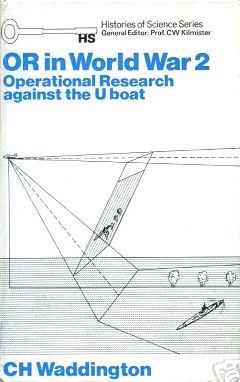
I was reminded of this story last week when I noticed a copy of a book about the WW2 battle against U-boats for sale as an unwanted book in the city library. It was written from the point of view of a naval historian, and I spent a few minutes looking to see whether there was any mention of O.R. and its place. Yes, O.R. was mentioned in two places. The first retold the story of the depth charges. The second was non-mathematical. It was the psychology of spotting an aircraft. And the O.R. group were credited with the idea that the underside of the attacking aircraft should be painted white, which would camouflage them against the sky. The O.R. people analysed the results afterwards and demonstrated that this simple measure increased the success rate by a further 30%.
Reflecting on these stories over the last few days, I wondered about two aspects of these stories.
First, how much do we encourage our fellow O.R. scientists to think about psychology and human behaviour?
Second, what are the stories of O.R. success that we can use to enthuse the next generation of O.R. people?
(In the latter context, I have used the success of airline O.R. groups in rescheduling U.S. flights after the atrocities of 9/11, and the role of O.R. in scheduling public transport for the Olympic Games in Beijing.)
Subscribe to:
Posts (Atom)