Showing posts with label multicriteria decisions. Show all posts

Monday, 13 September 2010

Fair Exchange in 1948

In 1948, the railways in the United Kingdom were nationalised by the then government. There were four (the "Big Four") railway companies operating in the country, and they acted independently of each other for many purposes. So, after nationalisation, British Railways had a fleet of steam engines from four different stables. Because of the war, many of these locomotives were past their best. Each of the companies had its own locomotive designers, and over the years, each company had developed its own style of locomotive design, to meet the topography of the region, and the objectives of its railway service.

The new management realised that this might be inefficient, so commissioned trials to help find a range of standard steam locomotives. So they mixed and matched, taking locomotives from one stable and running them on the other types of track. The aim was to find the "best".

Now, one of the first questions one asks in O.R. is "What do you mean by best?" According to the history of the 1948 Exchange, nobody really thought of this. Obviously it is a multi-criteria problem, and there are several types of locomotive to be identified and designed. But, even for one type, such as hauling express trains, there are various criteria to consider. The Wikipedia article about the exchange comments:
the testing had little scientific rigour, and political influence meant that LMS practice was largely followed by the new standard designs regardless.

So the optimum was found, not so much by scientific analysis, but by politics. O.R. scientists, beware!

And a little footnote from the book which started me on this story, Amazing and Extraordinary Railway Facts by Julian Holland:
One eminent railway historian was shocked that the Stanier Black 5 type had performed badly; it appeared that the driver and fireman had tried to minimise the fuel consumption during the trial.

So, of course if your staff don't understand the aim of the experiment, they may interpret it in the wrong way. Beware!
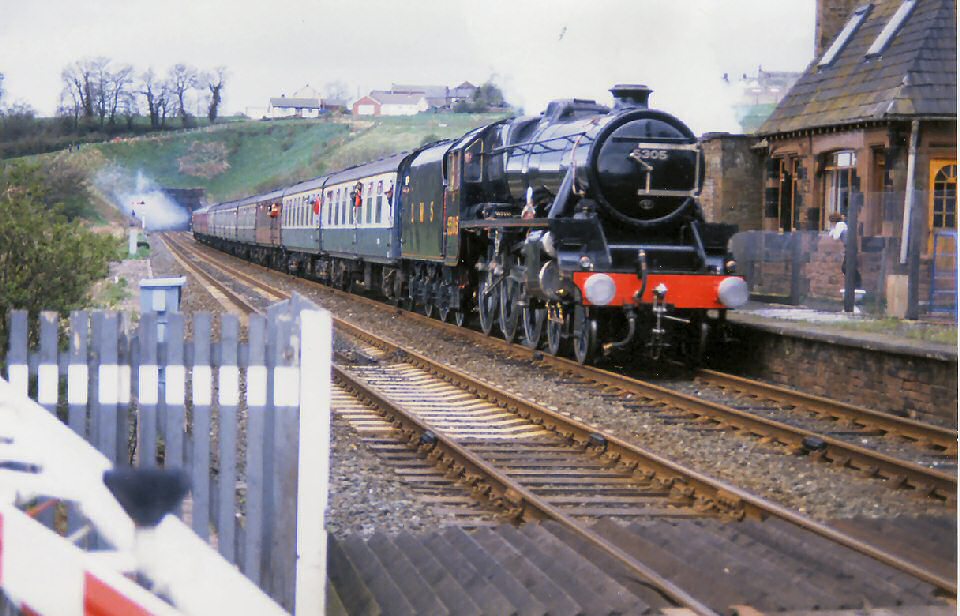


A Stanier Black 5

Monday, 23 August 2010

Cutting your hedge

When I taught a course on multiple-criteria decisions, I used the frequency of hedge cutting as an example of conflicting objectives. Should you cut the farm hedges each year, or every two years, or every three years? The more often you cut, the more it costs, but each cut costs less. And hedge-cutting around a farm happens close to harvest time, so there are other annual tasks to schedule. The location of the hedge also matters. Those by tracks need more frequent trimming than others.

Visiting Old Walls Hydro reminded me of these, because the site has just achieved a high standard of conservation, and one requirement is that hedges are trimmed every three years. But there is a complication which I had overlooked in my course. In three years, some hedgerow trees get so large that a sapling in year 0 is a substantial tree in year 3. Should you trim that tree? Or allow it to grow to be a tree?

Wednesday, 17 February 2010

Small schools and multiple criteria

The county of Devon, where I live, has many areas where there are small villages and few towns. The population is concentrated in the towns and cities, but a significant number of people live in the villages and commute, or work locally. Today there has been some discussion about the provision of education for children and a report about Devon has identified several primary schools with fewer than 30 children in the whole school (age 5 to 11) and one secondary school with less than 500 children. The report raises the question about the viability of such schools, based on the cost per capita. Fairly obviously, education is an area where there are economies of scale -- you need a couple of teachers at least in each school, you need buildings and these must be heated and lit whther there are 10 children or 50.

So should small schools be closed and the pupils transferred to larger ones, where the cost per child will be smaller? I suggest that this would make an interesting question for an examination on multiple criteria optimisation or soft systems. There are other factors than the cost per capita to consider. Schools in small communities are a social focus for those communities. Families and children belong to them. What are the effects on children if they have to spend an extra hour at each end of the school day in travel?

Listening to the radio discussion this morning reminded me, once again, that operational research needs to be multidisciplinary. The figures matter, but behind those figures are people with needs and aspirations that cannot be measured.

Friday, 27 March 2009

The coin machine problem

Yesterday I saw inside a new machine and realised that its designers had solved an interesting multicriteria problem.

Many British supermarkets have introduced self-service checkouts; the shopper brings their basket to the machine, scans the items one by one without the need for a cashier, and pays by card or by cash at the end. I use one such supermarket regularly when buying a few items, because it is generally quicker than queueing for a cashier. As I have used it, I have been interested in the algorithm it follows for giving change for cash purchases. The first part of the algorithm is straightforward; if your bill is for P pence, then as soon as you have inserted any sum greater than P, the machine gives change. (So if you want to get rid of small change, then you must put that small change in before the larger coins.) But the second part concerns the coins that are dispensed as change.

British coins have values 1, 2, 5, 10, 20, 50, 100 and 200 (pence). My change has never included coins of value 2, 50 or 200. 9 pence in change is dispensed as four 1s and one 5. 90 pence in change is dispensed as one 10 and four 20s. So when I found staff maintaining one of the machines, I stopped to look (probably being labelled by the CCTV operators as a suspicious character). There were six storage receptacles for coins to be given as change, labelled 1, 5, 10, 20, 100, 100. So there is no way that I could be given a 2, a 50 or a 200.

The designers needed a design that worked with an algorithm. Have a stock of coins to give change in a logical way, and keep that stock inside a small volume. So they eliminated three coins from inclusion. So, objective 1: Be able to give change; objective 2: keep the number of storage bins to a logical minimum. But there was a subtle objective 3: use coins of small volume, to maximise the number of coins in the machine.

2 pence coins are larger in volume than those of value 1, 5, 10 and 20. 50 pence coins are larger than 2 pence. 200 pence (2 pound) coins are very large. So these were the coins to remove from the machine's design.

Now, was this design a multicriteria O.R. problem, or not? I think it was -- even if it has a solution that will not shake the world! But it does make the world a little better.