The Commissioner for Victims of Crime Louise Casey has called for the right to trial by jury to be stopped for everything other than major crimes such as rape and murder. Casey said: "Defendants should not have the right to choose to be tried by a jury over something such as the theft of a bicycle or stealing from a parking meter."
How valuable is a bicycle? Louise Casey obviously thinks that they are cheap, that cycle crime is minor and trivial. But, has she bought a bike recently? Bikes cost a lot more than the money you can get out of a parking meter, with many worth over £1000, more than some cars. Moreover, organised criminal gangs are responsible for stealing thousands of pounds worth of bikes: for their victims, this is not a trivial matter. According to the British Crime Survey, 480,000 bikes are stolen every year.
(Some of the above has come from the Cyclist's Touring Club (www.ctc.org.uk)). For O.R. scientists, her misconception is a warning; make sure that everyone knows (or agrees) the real value of items in your studies. The classic area is placing a value on the cost of inventory. How much does it cost to store one widget for one time period?
Friday, 5 November 2010

How big a sample? Follow up.
The results of my sample (blog of October 25 2010) came back this week, and they show no trace of cancer. Thank God!
However, in these days of customised lettters, it was sad to see that the NHS could not use their data in a friendly way. Part of the letter applied to follow-up tests, which happen every two years between the age of 60 and 75 (don't ask how "every two years" fits into a fifteen year period) and then are optional. It is not too difficult to customise the letter to say either "We will invite you to a test in two years time" or "You have reached the age when testing becomes optional".
However, in these days of customised lettters, it was sad to see that the NHS could not use their data in a friendly way. Part of the letter applied to follow-up tests, which happen every two years between the age of 60 and 75 (don't ask how "every two years" fits into a fifteen year period) and then are optional. It is not too difficult to customise the letter to say either "We will invite you to a test in two years time" or "You have reached the age when testing becomes optional".
Monday, 25 October 2010
How big a sample?
I am always interested in how people reach a decision which involves a numerical answer, because this is often related to O.R.. What follows may be thought to be slightly distasteful -- you have been warned.
One reason for not writing any blogs for several weeks has been travels on holiday, to which I may return later. In the middle of these, I passed a milestone birthday, which was duly celebrated. Soon after that, I received a letter from the National Health Service telling me that they screen all men of my age and over for cancer of the bowel. To do this required me to take samples from material which had passed through that part of my body. (Do I need to say more? No? Good.)
The sample scheme asked for samples from three pieces of material (produced at different times) and two smears from each one, giving six specimens.
So, questions: why two smears? why three pieces? Why not fewer from each and more pieces? I don't know the reasoning, but suspect that the answer is psychological as well as physical. Two eliminates some possibility of contamination. Three is enough for the average person to cope with. Put together, there are enough specimens for the analysts to look at, and reduce the risk of false positives and overlooking the symptoms by accident.
One reason for not writing any blogs for several weeks has been travels on holiday, to which I may return later. In the middle of these, I passed a milestone birthday, which was duly celebrated. Soon after that, I received a letter from the National Health Service telling me that they screen all men of my age and over for cancer of the bowel. To do this required me to take samples from material which had passed through that part of my body. (Do I need to say more? No? Good.)
The sample scheme asked for samples from three pieces of material (produced at different times) and two smears from each one, giving six specimens.
So, questions: why two smears? why three pieces? Why not fewer from each and more pieces? I don't know the reasoning, but suspect that the answer is psychological as well as physical. Two eliminates some possibility of contamination. Three is enough for the average person to cope with. Put together, there are enough specimens for the analysts to look at, and reduce the risk of false positives and overlooking the symptoms by accident.
Monday, 13 September 2010
Fair Exchange in 1948
In 1948, the railways in the United Kingdom were nationalised by the then government. There were four (the "Big Four") railway companies operating in the country, and they acted independently of each other for many purposes. So, after nationalisation, British Railways had a fleet of steam engines from four different stables. Because of the war, many of these locomotives were past their best. Each of the companies had its own locomotive designers, and over the years, each company had developed its own style of locomotive design, to meet the topography of the region, and the objectives of its railway service.
The new management realised that this might be inefficient, so commissioned trials to help find a range of standard steam locomotives. So they mixed and matched, taking locomotives from one stable and running them on the other types of track. The aim was to find the "best".
Now, one of the first questions one asks in O.R. is "What do you mean by best?" According to the history of the 1948 Exchange, nobody really thought of this. Obviously it is a multi-criteria problem, and there are several types of locomotive to be identified and designed. But, even for one type, such as hauling express trains, there are various criteria to consider. The Wikipedia article about the exchange comments:
the testing had little scientific rigour, and political influence meant that LMS practice was largely followed by the new standard designs regardless.
So the optimum was found, not so much by scientific analysis, but by politics. O.R. scientists, beware!
And a little footnote from the book which started me on this story, Amazing and Extraordinary Railway Facts by Julian Holland:
One eminent railway historian was shocked that the Stanier Black 5 type had performed badly; it appeared that the driver and fireman had tried to minimise the fuel consumption during the trial.
So, of course if your staff don't understand the aim of the experiment, they may interpret it in the wrong way. Beware!

A Stanier Black 5
The new management realised that this might be inefficient, so commissioned trials to help find a range of standard steam locomotives. So they mixed and matched, taking locomotives from one stable and running them on the other types of track. The aim was to find the "best".
Now, one of the first questions one asks in O.R. is "What do you mean by best?" According to the history of the 1948 Exchange, nobody really thought of this. Obviously it is a multi-criteria problem, and there are several types of locomotive to be identified and designed. But, even for one type, such as hauling express trains, there are various criteria to consider. The Wikipedia article about the exchange comments:
the testing had little scientific rigour, and political influence meant that LMS practice was largely followed by the new standard designs regardless.
So the optimum was found, not so much by scientific analysis, but by politics. O.R. scientists, beware!
And a little footnote from the book which started me on this story, Amazing and Extraordinary Railway Facts by Julian Holland:
One eminent railway historian was shocked that the Stanier Black 5 type had performed badly; it appeared that the driver and fireman had tried to minimise the fuel consumption during the trial.
So, of course if your staff don't understand the aim of the experiment, they may interpret it in the wrong way. Beware!
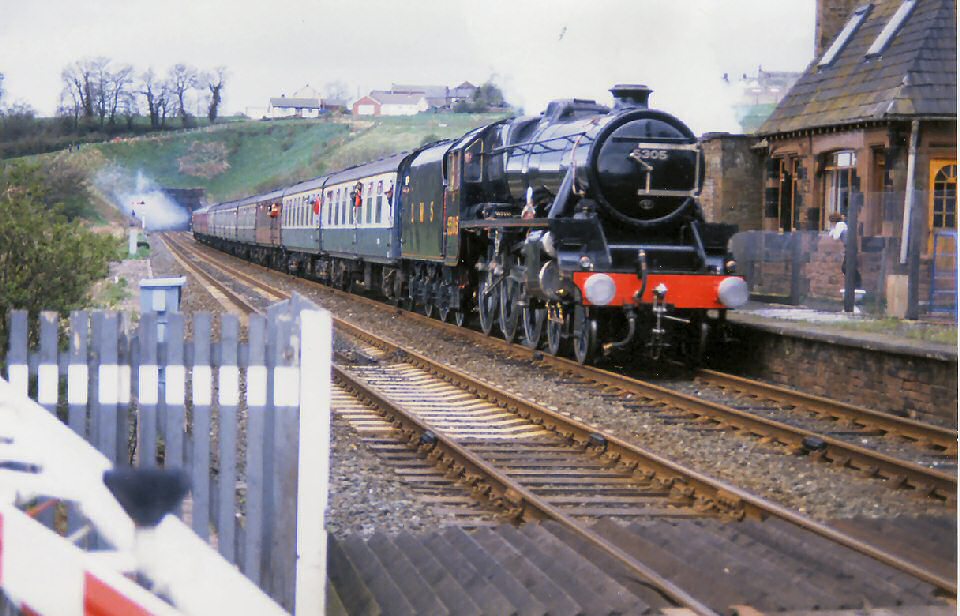
A Stanier Black 5
Tuesday, 31 August 2010
The abuse of forecasting
Mention the name "Gene Woolsey" to operational research scientists of the 1970s and 1980s, and you will probably get the reaction that he spoke and wrote great deal of common sense, mostly in "Interfaces". One of his stories is how he did a study in a particular factory, and a couple of years later returned on a visit. He said that he wanted to creep away quietly; the solution that he had proposed had been pinned on a board, and was being followed to the last detail. In the intervening years, the environment had changed, so all the external parameters of the model were different, making the solution totally inappropriate.
I thought of Gene last week, when our gas company sent us "Your Annual Gas Statement". It reads
"We've tried to make it as easy as possible to understand."
"Your usage: From 25 Aug 2009 to 24 Aug 2010, you used 15396.49 KWh of gas.
If you continue to use energy at the same rate over the next 12 months, we forecast your cost will be £568.21"
What wonderful precision! Especially as the power consumption is based on reading a meter which is accurate to +/-1 metric unit, and one of those is between 11 and 12 KWh. So, the meter can't determine whether we used 15390 or 15400 KWh, so the last three significant figures of their record are unnecessary. That translates to making the pence in the forecast unnecessary. But these errors are tiny in comparison with the assumptions that we will continue to use energy at the same rate.
It worries me that somebody has thought that this information is intended to be useful. If it was someone from the O.R. department, then I suggest that they creep away quietly now.
If you are from, or know someone from, the O.R. department of British Gas, do let them know of the abuse of forecasts.
I thought of Gene last week, when our gas company sent us "Your Annual Gas Statement". It reads
"We've tried to make it as easy as possible to understand."
"Your usage: From 25 Aug 2009 to 24 Aug 2010, you used 15396.49 KWh of gas.
If you continue to use energy at the same rate over the next 12 months, we forecast your cost will be £568.21"
What wonderful precision! Especially as the power consumption is based on reading a meter which is accurate to +/-1 metric unit, and one of those is between 11 and 12 KWh. So, the meter can't determine whether we used 15390 or 15400 KWh, so the last three significant figures of their record are unnecessary. That translates to making the pence in the forecast unnecessary. But these errors are tiny in comparison with the assumptions that we will continue to use energy at the same rate.
It worries me that somebody has thought that this information is intended to be useful. If it was someone from the O.R. department, then I suggest that they creep away quietly now.
If you are from, or know someone from, the O.R. department of British Gas, do let them know of the abuse of forecasts.
Monday, 23 August 2010
Cutting your hedge
When I taught a course on multiple-criteria decisions, I used the frequency of hedge cutting as an example of conflicting objectives. Should you cut the farm hedges each year, or every two years, or every three years? The more often you cut, the more it costs, but each cut costs less. And hedge-cutting around a farm happens close to harvest time, so there are other annual tasks to schedule. The location of the hedge also matters. Those by tracks need more frequent trimming than others.
Visiting Old Walls Hydro reminded me of these, because the site has just achieved a high standard of conservation, and one requirement is that hedges are trimmed every three years. But there is a complication which I had overlooked in my course. In three years, some hedgerow trees get so large that a sapling in year 0 is a substantial tree in year 3. Should you trim that tree? Or allow it to grow to be a tree?
Visiting Old Walls Hydro reminded me of these, because the site has just achieved a high standard of conservation, and one requirement is that hedges are trimmed every three years. But there is a complication which I had overlooked in my course. In three years, some hedgerow trees get so large that a sapling in year 0 is a substantial tree in year 3. Should you trim that tree? Or allow it to grow to be a tree?
Models for hydroelectricity
Last week Tina and I visited the Old Walls Hydro site in Ponsworthy on Dartmoor. Water is taken from the West Webburn river and diverted along a leat to give a 16 metre head of water for two turbines. As a piece of engineering it is fascinating.
Various aspects of the design reminded me of some operational research principles. For parts of the design, the owners were told that what they proposed was impossible. How many times does an O.R. scientist or team meet such prejudice? Too often. Sometimes the problem is posed with a feasible region that is too small, simply because nobody has pushed the limits. Beware of incorrect definitions of feasibility!
Then, there were matters of feedback. One of these concerned filtering the water before it entered the pipes to the turbines. Leaves and other vegetation falls into the leat and is trapped on a wire mesh conveyor belt. Once sensors detect that there is a difference in the level of water before and after this screen, a motor starts and removes a "belt-load" of debris. How should this be powered? The simple answer would be to take the power from the turbines ... but that can be affected by the presence of the debris and could cause the system to collapse. So, the motor is isolated from the hydro power. It runs on a small battery, which of course is then trickle charged from the turbines. The O.R. lesson is that feedback needs to be controlled, so that it gives useful control at all times, and not in ideal conditions.
Various aspects of the design reminded me of some operational research principles. For parts of the design, the owners were told that what they proposed was impossible. How many times does an O.R. scientist or team meet such prejudice? Too often. Sometimes the problem is posed with a feasible region that is too small, simply because nobody has pushed the limits. Beware of incorrect definitions of feasibility!
Then, there were matters of feedback. One of these concerned filtering the water before it entered the pipes to the turbines. Leaves and other vegetation falls into the leat and is trapped on a wire mesh conveyor belt. Once sensors detect that there is a difference in the level of water before and after this screen, a motor starts and removes a "belt-load" of debris. How should this be powered? The simple answer would be to take the power from the turbines ... but that can be affected by the presence of the debris and could cause the system to collapse. So, the motor is isolated from the hydro power. It runs on a small battery, which of course is then trickle charged from the turbines. The O.R. lesson is that feedback needs to be controlled, so that it gives useful control at all times, and not in ideal conditions.
Subscribe to:
Posts (Atom)