One of the problems of queues which involve people is to forecast when and at what rate the customers will arrive. Recently, the UK supermarket giant, Tesco, made a spectacular mistake in the run up to the Christmas rush and the holidays. Here's the story:
---------------
The Tesco Big Christmas Exchange
Back in November 2010, Tesco announced it was launching a Big Clubcard Voucher Exchange. Lasting four weeks, it gave collectors of Clubcard points the opportunity to double the value of their vouchers on a large range of non-food items, ranging from wine and computers to Christmas decorations.
A similar scheme was launched earlier in the year. However, Tesco trumpeted the fact that this time the scheme had been revamped, so now customers would be able to exchange their vouchers online.
But it went wrong
The scheme was launched around the time that most customers received their November points statement, early in November. If you wanted to double up your vouchers, the closing date was Sunday 5 December.
Clearly Tesco expected the bulk of interested shoppers to take part once they got their statement through, rather than leave it to the last minute. This was very much a mistake, as news reports and Internet message boards are awash with tales of shoppers facing enormous queues to exchange their vouchers, only to give up and try and do it online. With predictable results, the Tesco website collapsed under the weight of so many users.
------------------
Yes, it was bad understanding of psychology, leading to not enough provision of servers for the customers. There is a great deal of literature about call centres and the behaviour of customers, so someone should have been aware of the likely rush at the end. And, I suspect, there should have been some monitoring of the rate of redemption of the vouchers, which might have given advance warning of the changing rate of redemption. If only 10% of the customers redeemed their points in the first half of the offer, then it might be foreseen that there would be a great demand in the second half.
Showing posts with label psychology. Show all posts
Showing posts with label psychology. Show all posts
Thursday, 9 December 2010

Monday, 24 August 2009
More about psychology
It is salutary to remember that the second world war, which had such an influence on my childhood, is now studied as "history" at schools. Although I was born several years afterwards, the war was sufficiently recent to affect me in various ways. Added to the change in "distance" is the change in technology and communication.
It was natural for my training in O.R. to begin with a little of the background to O.R. from WW2; we were all peers, in the sense that we had grown up with family experiences from parents and relatives of the horrors of that conflict. And our lecturers on the postgraduate O.R. programme had either experienced the pioneering wartime years of O.R., or had been mentored by those who had been involved. One of the first case-studies we heard about was the classic of "O.R. against the U-boat".
(The O.R. pioneers had been asked to try an improve the success of depth charges used against enemy submarines. The main numerical control in a depth charge is the depth at which the explosive is triggered, by the pressure of water. Until O.R. was brought in, the calculations assumed that a submarine dived immediately at the time it was sighted by the approaching aircraft. Therefore the depth was set at about 150 feet. The O.R. team convinced the military that the deth should be set much less, since submarines did not dive as quickly as had been assumed, and the accuracy of the aircraft was greater for a submarine that remained visible for longer. Suffice it to say that the "success" rate increased. This is pictured on the cover of an out-of-print book.)
I was reminded of this story last week when I noticed a copy of a book about the WW2 battle against U-boats for sale as an unwanted book in the city library. It was written from the point of view of a naval historian, and I spent a few minutes looking to see whether there was any mention of O.R. and its place. Yes, O.R. was mentioned in two places. The first retold the story of the depth charges. The second was non-mathematical. It was the psychology of spotting an aircraft. And the O.R. group were credited with the idea that the underside of the attacking aircraft should be painted white, which would camouflage them against the sky. The O.R. people analysed the results afterwards and demonstrated that this simple measure increased the success rate by a further 30%.
Reflecting on these stories over the last few days, I wondered about two aspects of these stories.
First, how much do we encourage our fellow O.R. scientists to think about psychology and human behaviour?
Second, what are the stories of O.R. success that we can use to enthuse the next generation of O.R. people?
(In the latter context, I have used the success of airline O.R. groups in rescheduling U.S. flights after the atrocities of 9/11, and the role of O.R. in scheduling public transport for the Olympic Games in Beijing.)
It was natural for my training in O.R. to begin with a little of the background to O.R. from WW2; we were all peers, in the sense that we had grown up with family experiences from parents and relatives of the horrors of that conflict. And our lecturers on the postgraduate O.R. programme had either experienced the pioneering wartime years of O.R., or had been mentored by those who had been involved. One of the first case-studies we heard about was the classic of "O.R. against the U-boat".
(The O.R. pioneers had been asked to try an improve the success of depth charges used against enemy submarines. The main numerical control in a depth charge is the depth at which the explosive is triggered, by the pressure of water. Until O.R. was brought in, the calculations assumed that a submarine dived immediately at the time it was sighted by the approaching aircraft. Therefore the depth was set at about 150 feet. The O.R. team convinced the military that the deth should be set much less, since submarines did not dive as quickly as had been assumed, and the accuracy of the aircraft was greater for a submarine that remained visible for longer. Suffice it to say that the "success" rate increased. This is pictured on the cover of an out-of-print book.)
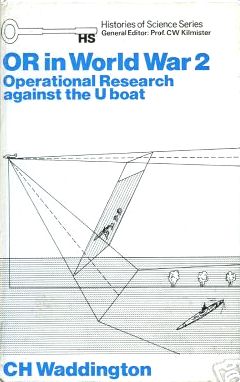
I was reminded of this story last week when I noticed a copy of a book about the WW2 battle against U-boats for sale as an unwanted book in the city library. It was written from the point of view of a naval historian, and I spent a few minutes looking to see whether there was any mention of O.R. and its place. Yes, O.R. was mentioned in two places. The first retold the story of the depth charges. The second was non-mathematical. It was the psychology of spotting an aircraft. And the O.R. group were credited with the idea that the underside of the attacking aircraft should be painted white, which would camouflage them against the sky. The O.R. people analysed the results afterwards and demonstrated that this simple measure increased the success rate by a further 30%.
Reflecting on these stories over the last few days, I wondered about two aspects of these stories.
First, how much do we encourage our fellow O.R. scientists to think about psychology and human behaviour?
Second, what are the stories of O.R. success that we can use to enthuse the next generation of O.R. people?
(In the latter context, I have used the success of airline O.R. groups in rescheduling U.S. flights after the atrocities of 9/11, and the role of O.R. in scheduling public transport for the Olympic Games in Beijing.)
Wednesday, 14 January 2009
The psychology of implementation of O.R.

It has been generally acknowledged in the O.R. that I have studied that implementing O.R. needs to recognise the psychology of the eventual user. There are numerous anecdotes and O.R. legends about this. The problem of elevators in the New York skyscraper is one of the oldest.
Office workers complained about the time they had to wait for elevators, so an O.R. team was asked to try and find an appropriate solution.
Various models were built in the investigation. These considered having more elevators, faster elevators, elevators that only stopped at particular floors. All were deemed insufficient.
Then the psychologist on the team proposed that there be full-length mirrors in the lobbies between the doors of the elevators. His argument was that these mirrors would reduce the perceived time of waiting; some people could arrange their clothing and check their hair; others could surreptitiously watch their fellow workers in the mirror. (The original story was sexist; this is the PC version.)
Result: no more complaints. The solution cost very little.
The same solution approach explains why you have magazines in waiting rooms, and automated advertising screens in bank and other queues. (Does anyone know of an airport where the queues are entertained by such screens? In those that I have visited, the queues have to watch endless reminders about what cannot be taken through security, or how to prepare for security.) And it also partly explains the popularity of glass-walled lifts, where there is something to watch while you are travelling.
(By the way, some statistics show that elevators are the safest form of transport in terms of deaths per passenger mile.)
Many years later, I came across a note about differing national psychologies. We were discussing the optimal timing of the red phase on traffic lights at a junction such as a cross roads. In heavy traffic, the throughput is maximised by having very long phases. The constraint is psychological; if the lights do not turn from red to green, those waiting at the red light start to become impatient. My informant suggested that two minutes was the limit in the UK, nearly three in the USA, and in Japan, the patient Japanese motorist only started to fret after four minutes. I'd be interested in knowing the basis for this.
Wednesday, 7 January 2009
Think of the user!
Good O.R. has to be implemented. Period. Full stop.
So, at some stage, someone needs to think of the person who will use the results. The problem may have been presented by management, and the person who pays for the work is in the management hierarchy, but the person who actually uses the results is probably not in management. Which is why implementation is important.
I have linked implementation and design before, but over the Christmas holiday we had experience of both good design (implementation) and bad.
Let's start with the bad news. We bought a new set of Christmas lights to make an arch around the front door. They came with an integral control box which had one button only. Repeated pressing of the button cycled through several patterns of flashing lights, with one where all bulbs stayed on all the time. So we put the string of lights up, switched on and discovered that the default was a pattern which faded and flashed -- too garish for us. So we cycled and selected the constant selection. Then we switched off, to put the string onto a time switch. When it came on, we were back to the default. As a result, at some stage every evening, yours truly had to press the button to select our favoured setting. With a little forethought, the designer could have ensured that the setting that had been selected became the default one for the next off--on sequence ... because that is what the user had expressed a wish to show what was wanted.
The good news was that Tina was given a DAB radio. Plug it in, switch it on, and set up the controls. It was extremely easy, with clear instructions, designed with the user in mind. Full marks for those at "Pure" for thinking of the user.
Tuesday, 16 September 2008
Operational Research and Psychology
Well, actually, as many people have pointed out in the past, psychology is part of O.R., so my title creates a false split.
A part of my education in O.R. was the apocryphal story about the O.R. consultants and the problem of the lifts in the skyscraper. Occupants of the building complained about the time they spent waiting for the lifts to get from the upper floors to the lobby. So the consultants looked at the options, they built models of the consequences of extra lifts, faster lifts, dedicated lifts from the upper floors, etc., etc. The reduction in mean waiting time was always very small. Then the psychologist in the team suggested that the company place mirrors in the waiting areas for each lift shaft. He explained why. Why? (see the end of this blog)
I had the same sort of problem at the weekend. Each year, on the second Saturday in September, I take part in a prayer walk around the churches of the city of Exeter, my home. The idea is that a group will start early in the morning, follow a winding route around the city, stopping to pray in about 25 different churches, praying for the city and its people. I have the responsibility of planning the route; for several years we have used the same route. This is not a TSP, of course, because the walkers don't end at the start point. It is not quite minimal but is quite close to the best.
In 2008, two new churches came into the list of city churches. We decided to include one of them, miss the other, and omit another, because it was linked strongly with these two. But the selected new church would add so much extra mileage to the old route that we needed a new plan. So we made the walk have two starts, with two groups starting at 8am and converging on the cathedral at 10am to walk for the rest of the day together. So I devised such a route; the two initial legs had minimal lengths for the churches that they visited, given the fixed end at 10am. However, I had forgotten the psychology. The second route had a lot of road walking, and went past the main railway station, so there was traffic. The consensus was that it would be better to walk a little further (about 300 to 400 metres) and walk beside the river on a footpath, away from the traffic. So that is what we will probably do next year -- alter the start and route to give more traffic-free paths.
Why the mirrors? The reason was that it was not the actual waiting time that people notices, but the perceived waste of time. Mirrors distracted people; some could admire themselves and tidy their clothes and appearance, others could watch. (In the 1970's there were sexist stereotypes for these activities, which I will not repeat.)
Subscribe to:
Posts (Atom)